How Green Ammonia and Nitric Acid Plants Work
From renewable electricity to fertilisers and industrial chemicals
Green ammonia connects renewable electricity with the production of nitrogen-based chemicals. Water supplies hydrogen, air supplies nitrogen, and renewable power provides the energy to bring them together. The resulting ammonia can be supplied as a product or used as feedstock for downstream chemical production. This is one of the industrial applications of Power-to-X, where electricity is converted into useful molecules.
Nitric acid extends this production chain. By converting ammonia into nitric acid, an integrated plant can supply materials used in fertilisers and other industrial products. Reducing the environmental footprint of this chain requires attention to both the ammonia feedstock and the emissions generated during nitric acid production.
What is green ammonia?
Ammonia, with the chemical formula NH₃, is a compound of nitrogen and hydrogen. Green ammonia is produced using renewable hydrogen, typically generated by water electrolysis powered by renewable electricity, and nitrogen separated from the air. The distinction lies in how the feedstock and energy are supplied, rather than in a different ammonia molecule.
Conventional ammonia production relies heavily on fossil fuels, both as a hydrogen source and for process energy. Replacing fossil-derived hydrogen with renewable hydrogen provides a route to substantially reduce production-related emissions. Ammonia remains an important feedstock for nitrogen fertilisers and a range of industrial chemicals.
How a green ammonia plant works
Renewable electricity and water preparation
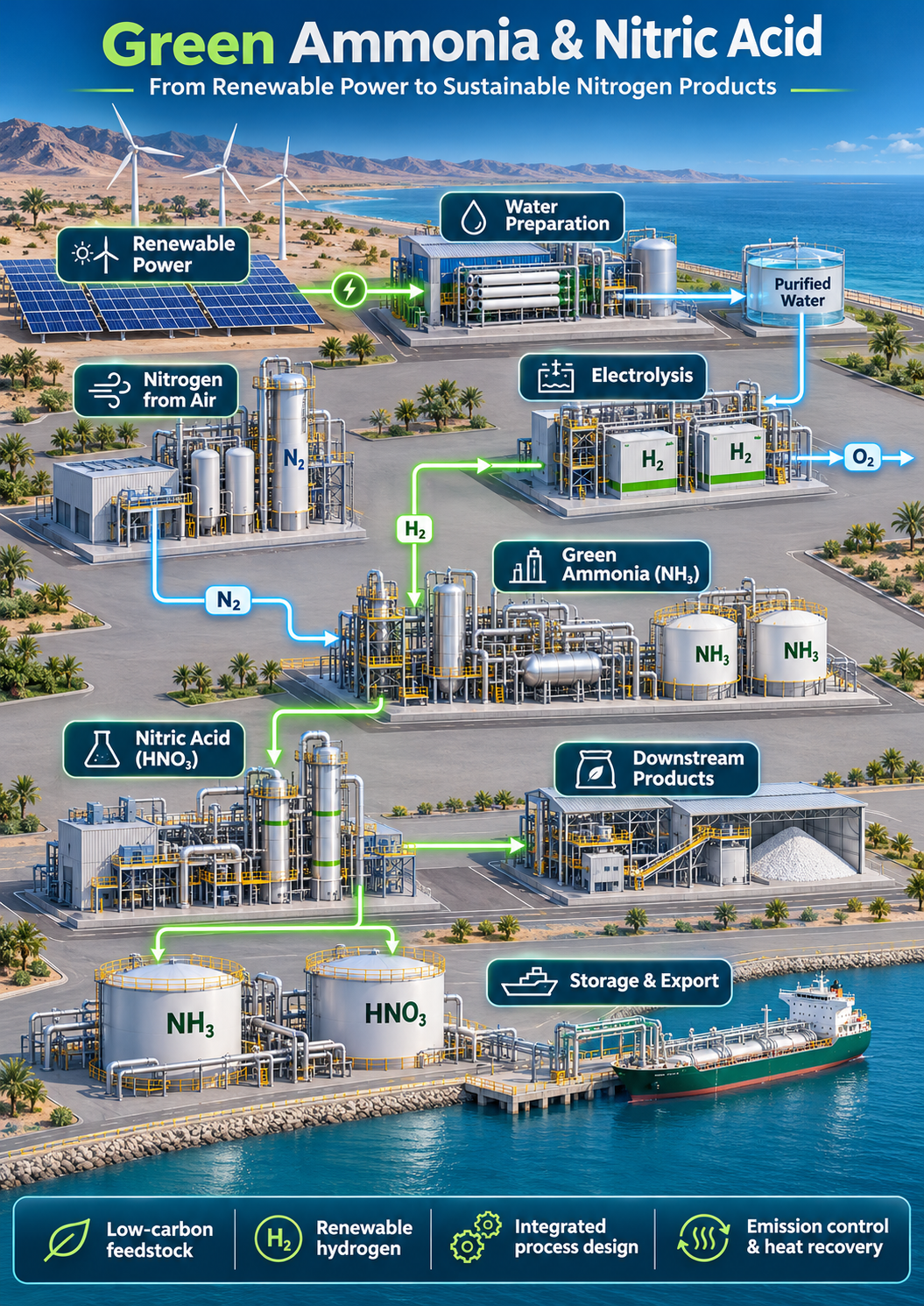
The process begins with renewable electricity, such as power generated by solar and wind plants. Water must be treated to meet the electrolyser’s quality requirements before it enters the hydrogen production system. Where seawater is the source, desalination forms part of the water-treatment process.
Hydrogen production through electrolysis
Inside the electrolyser, electricity splits water into hydrogen and oxygen. Hydrogen becomes the feedstock for ammonia production, while oxygen leaves the electrolysis process as a separate stream. The electrolyser is therefore the link between the renewable power supply and the chemical production plant.
Nitrogen separation and ammonia synthesis
Nitrogen is separated from ambient air and combined with hydrogen in the Haber–Bosch process. The gases react over a catalyst under elevated pressure and temperature to produce ammonia. In a renewable production route, the hydrogen comes from electrolysis rather than fossil-fuel reforming.
The production principle is straightforward:
Renewable electricity and water → Green hydrogen
Green hydrogen and nitrogen from air → Green ammonia
Operating the plant reliably requires more than connecting these process units. Hydrogen availability varies with the electricity supply, so the ammonia synthesis system must be designed around the expected feedstock profile and its operating flexibility.
How ammonia becomes nitric acid
Nitric acid, with the chemical formula HNO₃, is manufactured from ammonia through the Ostwald process. Using green ammonia changes the upstream production footprint; the nitric acid plant still performs the established chemical conversion from ammonia to acid.
First, ammonia reacts with oxygen from air over a catalyst to produce nitric oxide. The nitric oxide is then further oxidised to nitrogen dioxide. These nitrogen oxides pass into an absorption system, where reaction with water produces nitric acid.
The plant also offers opportunities for energy recovery. Ammonia oxidation releases heat, which can be recovered to generate steam for use within the process or, where the site energy balance permits, supplied to other facilities. Heat recovery should therefore be considered when integrating the nitric acid plant with the wider industrial complex.
The required acid concentration and plant configuration depend on the intended application. Nitric acid technology can be configured for fertiliser production or other chemical-industry requirements, with the process selected to balance product specification, investment cost, operating cost and energy efficiency.
What makes nitric acid lower-emission?
Green ammonia alone does not make nitric acid production emission-free.
During ammonia oxidation, side reactions can form nitrous oxide, or N₂O, a greenhouse gas. These emissions can occur even when the ammonia feedstock has been produced using renewable electricity. A lower-emission nitric acid plant must therefore address the acid-production process as well as the upstream hydrogen and ammonia supply.
Nitric acid plants also need to control nitrogen oxides, or NOₓ, in their exhaust gases. NOₓ and N₂O are different pollutants and require an appropriate treatment strategy. Catalytic abatement systems are available to reduce both, with the configuration selected for the plant’s gas conditions and operating requirements.
The design objective should be to combine renewable feedstock, efficient energy use and effective process-emissions control. Any environmental claim should describe which parts of the production chain it covers and be supported by measured performance, rather than relying on the “green” designation of the ammonia alone.
Designing the plants as an integrated system
A green ammonia and nitric acid complex brings together renewable generation, hydrogen production, ammonia synthesis and downstream chemical processing. These facilities have different operating characteristics. Solar and wind output varies, while the synthesis and downstream plants must remain within their permitted operating ranges. Storage and process flexibility are therefore important design considerations.
The engineering assessment should consider the complete operating sequence: when electricity is available, how hydrogen production responds, how ammonia output changes, and how the nitric acid plant receives its feedstock. Battery storage, hydrogen buffers, ammonia inventories and flexible plant operation should be evaluated according to the interruption or fluctuation each is intended to manage.
This assessment should use time-based production and consumption profiles, rather than annual energy totals alone. A project can have sufficient electricity over a year while still facing periods when generation and plant demand do not match.
Energy integration also deserves early attention. Nitric acid plants can recover process heat, and efficient heat-recovery designs can increase the energy available for use elsewhere. The actual benefit must be established through the project’s heat and utility balances; it should not be assumed that every installation will produce an exportable energy surplus.
From ammonia and nitric acid to downstream products
Ammonia is a starting material for mineral nitrogen fertilisers and is also used in industrial products such as plastics and synthetic fibres. Producing it through a renewable route allows the upstream production method to change while retaining the chemical feedstock required by these industries.
Nitric acid provides a further route into nitrogen-based products. In a downstream plant, ammonia and nitric acid can be combined to produce ammonium nitrate, an established material in fertiliser and industrial supply chains. Whether this additional stage is included depends on the project’s product strategy and intended market.
The product strategy should be established early. It determines how much ammonia is sold directly, how much is converted into nitric acid, and whether further downstream manufacturing forms part of the development. Those choices should guide plant capacity, storage requirements, utility design and logistics.
RBE’s role in project development
RBE supports renewable-energy and Power-to-X project development through feasibility studies, technology integration, energy procurement assessments, risk management and financial modelling. These services help connect technical choices with the commercial requirements of a proposed development.
For a green ammonia and nitric acid project, the feasibility assessment should address the complete production chain: renewable electricity, water supply, hydrogen generation, ammonia synthesis, nitric acid production, emissions treatment and product delivery. The objective is to establish a consistent project basis before individual systems are specified in detail.
Discuss your green ammonia and nitric acid project with RBE.